



- For Students, Parents/Carers
- Rewards
- The Behaviour System
- Careers Information & Guidance (Progression)
- Charging & Remissions
- E-Safety links and advice
- Free School Meals
- Remote Learning Provision
- Home Learning
- Home School Agreement
- Letters Home
- Mental Health and Wellbeing
- New Students
- Reading for Pleasure at Home
- Safeguarding
- Arbor Pay
- SEND
- Snow & Adverse Weather
- Children's Centre
- Enrichment
Options after Year 11
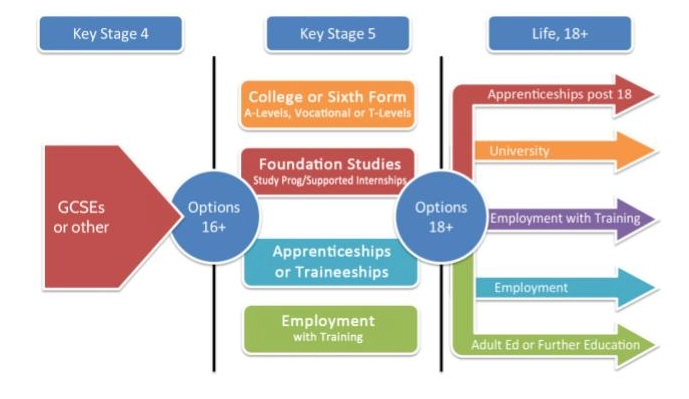
When you finish Year 11, you have several different options for your next steps. It is important to do some research and look at which option best suits you—considering your interests, your strengths, and your current situation.
If you find the choice confusing, talk to about you’re options to Mrs Pasfield, our careers adviser in school.
After Year 11, your main options include:
- Continuing to study full-time at a further education college, sixth form college, or school sixth form (studying A-Levels, Applied General Qualifications, T-levels or other vocational courses).
- Starting an Apprenticeship (combining work and study).
- Part-time education or training combined with employment, self-employment, or volunteering for 20 hours or more a week.
A Levels
A-Levels are academic qualifications studied over two years, and they are typically offered by further education colleges, sixth form colleges, and school sixth forms. Students usually select three A-Levels, which can include subjects previously taken atGCSE or completely new disciplines such as Law or Psychology. While choosing subjects that keep career options open is generally advisable, be aware that some specific careers, such as Medicine, require the selection of particular subjects. The general entry requirement is a minimum of five GCSEs at Grade 4 or above, including both English and Maths, although applicants should always confirm specific requirements with the institution they are applying to. A-Levels are primarily assessed through exams and provide a strong pathway to university or college study, higher and degree Apprencticeships, or direct employment.
T Levels
T-Levels are a relatively new two-year qualification equivalent to three A-Levels, designed collaboratively with employers to ensure students gain the specific skills and knowledge required for the modern workplace. They are being introduced progressively in further education and sixth form colleges across various subjects, including Digital, Health, Building Service Engineering, and Science. T-Levels feature a combination of classroom learning and a substantial, in-depth work placement lasting a minimum of 45 days. Assessment is carried out through a mix of exams, projects, and practical assignments, and successfully completing a T-Level can lead to university or college study, higher and degree Apprenticeships, or immediate skilled employment.
For more information on choosing the right subjects for a particular University degree course please see the following website:
Applied General Qualifications
Applied General Qualifications (AGQs) are vocational Level 3 courses, such as BTECs, that serve as an alternative to A-Levels, offering specialized learning in a specific career area like Business or Health & Social Care. Unlike the exam focus of A-Levels, AGQs use a mixed assessment model combining exams with substantial coursework, assignments, and practical projects. They are flexible in size, ranging from qualifications equivalent to one A-Level (often combined with other courses) up to three A-Levels. Successful completion of an AGQ awards UCAS Tariff Points, making it a widely accepted pathway to university study, higher apprenticeships, or skilled employment, particularly suiting students who thrive with continuous assessment and applied, real-world learning. These can often be taken alongside A-levels. View the Temple Moor Prospectus here:
Apprenticeships
Apprenticeships are jobs with training and are available at different levels depending on what qualifications you have.; the levels are intermediate, advanced and degree Apprenticeships and are in a wide range of career areas, for example, digital industries, childcare, paralegal, teaching, business and surveying. You will be paid a wage and based most of your time in your workplace and some of the time may be spent in a college or training centre and will gain qualifications related to your job. You can progress to the next level of Apprenticeship, other employment or to university.
Foundation Courses
Foundation courses are available in further education colleges and with training providers. If you don’t have the qualifications to go into a higher-level course at college or not ready to progress to a Traineeship or Apprenticeship, these may be the next best step for you. You will get help and support to prepare for work, study and personal development skills. Talk to your teacher or careers adviser in school about what options would suit you best.
- For Students, Parents/Carers
- Rewards
- The Behaviour System
- Careers Information & Guidance (Progression)
- Charging & Remissions
- E-Safety links and advice
- Free School Meals
- Remote Learning Provision
- Home Learning
- Home School Agreement
- Letters Home
- Mental Health and Wellbeing
- New Students
- Reading for Pleasure at Home
- Safeguarding
- Arbor Pay
- SEND
- Snow & Adverse Weather
- Children's Centre
- Enrichment